

After a cyclist fell and suffered an ankle injury, MEA Forensic was asked to analyze a home-security video to determine whether a passing car contributed to the crash.
The Event:
An injured cyclist claimed that he was riding close to the curb when he was clipped by a passing car, which caused him to fall to the ground and injure his ankle. Shortly after the incident, a home-security video was posted on a publicly-available website that captured the event. We were asked if we could determine the precise speeds and positions of the cyclist and the car, and clarify whether there was contact between them.
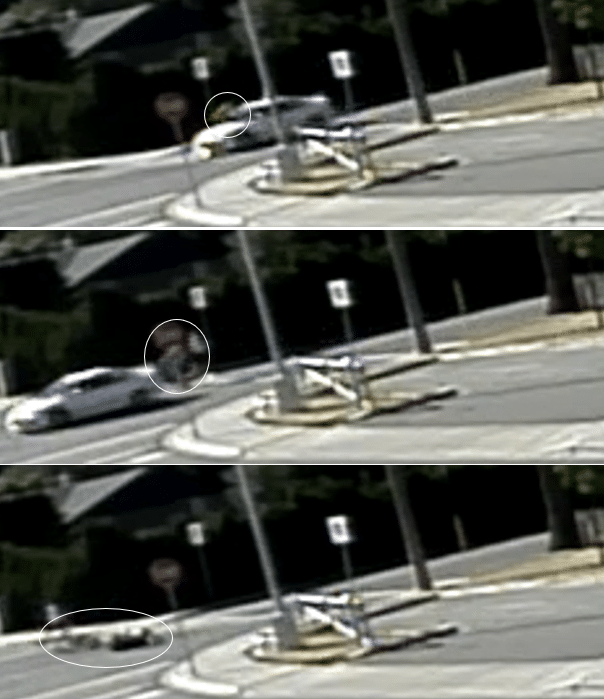
Video frames showing the car passing the cyclist (circled).
Our Analysis:
First, we visited the location of the event and conducted laser scans of the area visible in the video. A 3D computer model was created from these scans in which the view of the video camera could be replicated. Our engineer then interrogated the video using specialized software to extract individual frames, and establish that the frame rate was a steady 30 frames per second. This means that each frame was 1/30th of a second apart; key information for determine the timing of events and speeds.
Next, we overlaid the 3D scene model with individual video frames to replicate the camera’s view. This involved determining the location and direction of the camera and correcting for lens distortion. Then, 3D models of the cyclist and the car were placed in the 3D scene to match the positions of the actual cyclist and the car in the individua video frames. Because the make and model of the car was unknown, this analysis was conducted for a range of possible vehicles. With positions and timing known, speeds were calculated: the cyclist slowed down from 28 to 22 km/h (18 to 14 mph) before he fell, and the car was travelling 58±3 km/h (36±2 mph) as it approached the cyclist.
The question of contact between the car and the cyclist proved more difficult to answer because of uncertainty in determining the precise lateral location of the cyclist on the road. There was uncertainty in the size and shape of the bicycle, the cyclist was obscured from view as the car passed, and the cyclist was a small object in the video and therefore described by only a few pixels. We found a different way to look at the problem. The cyclist testified that he was riding close to the curb (3 to 4 feet) and our position-matching analysis showed clearly that the car was positioned at the left side of its lane as it passed the cyclist. If the cyclist was riding where he recalled, the car would have passed him with feet to spare. Therefore, the cyclist was either further from the curb than he recalled, or contact did not occur.
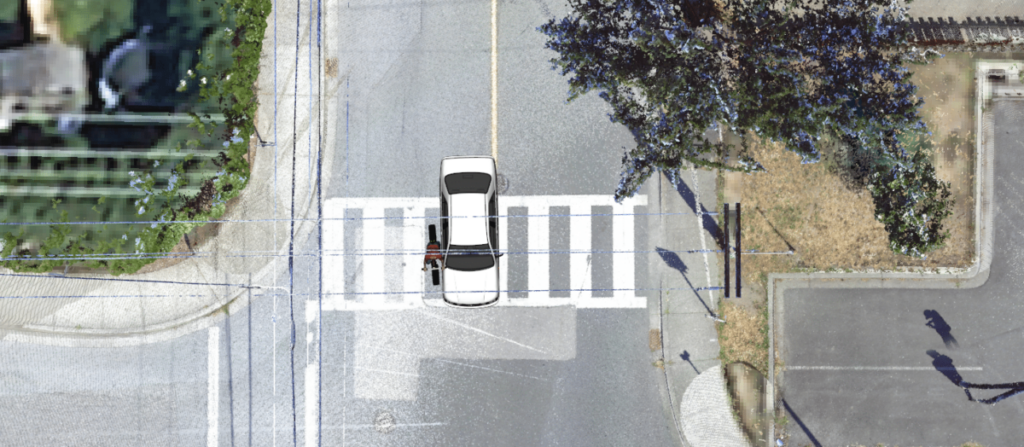
The results of the video analysis showed that in order for contact to have occurred, the cyclist had to have been riding in the middle of the car’s lane.
The Results:
A scientific approach to video analysis produced defendable speed values for the cyclist and the car, and insight into where they were in the moments leading up to the event. The MEA engineer responsible for the work prepared a report, responded to the work of an opposing expert, and testified in court about his opinions. In the Reasons for Judgement, the judge indicated that she preferred his opinion due to the thoroughness of the on-site inspection and the strength of the video analysis.