



Slips, trips and falls can do more than bruise the ego; they can also lead to serious injury and litigation. When a lawsuit follows, the liability arguments often rest on whether a property defect or deficiency caused or contributed to the fall that led to the injury.
Biomechanical engineers are mechanical engineers with a particular expertise in human body mechanics. They understand the science behind how humans physically interact with their environment. Through a thorough investigation of a fall incident, they can help answer two key questions: First, was there a defect in the built environment, or has a written or implied safety standard been violated? Second, did this defect cause or contribute to the incident?
Below, we will discuss these two questions in more detail and provide tips for how you can work with a biomechanical engineer to have these questions answered.
First, why do people fall?
Various regulations, technical standards and guidelines govern our built environment. The design, construction, and maintenance of municipal sidewalks, commercial or residential buildings, playgrounds and other spaces are all usually governed by one or more standards. At their most basic level, these standards help create safe structures, for instance, by ensuring that a building is structurally sound or that a balcony has a railing. Equally important, however, is that these standards help standardize our environment. Standardization creates expectation. When climbing up a staircase, for example, we may not make a conscious decision about our foot placement on each step because, based on our experience climbing stairs, we expect each step to be relatively uniform in depth and height.
When our built environment violates standards through poor design, construction error, or inadequate maintenance, it takes us by surprise, and can lead to an injury. In other words, when someone falls, it is usually not because the defect they encountered was insurmountable, but rather because they didn’t expect it. Thus, a person capable of navigating highly technical terrain on a hiking trail can trip and fall on a staircase if a step is slightly higher than the steps before it. Similarly, a person capable of walking on a wet and slippery tile surface may slip when stepping from a dry to a wet area on the tile surface if they were not expecting the change.
Identifying Applicable regulations, Technical Standards, and Guidelines
The initial steps of an occupier’s liability investigation are to first determine which standards apply to the area where the incident happened, and to then determine whether there was a violation of these standards.
Standards exist in different forms: there may be a mandatory regional regulation, like a building code or municipal by-law; a mandatory industry-specific safety standard, like for amusement rides; or a voluntary guideline that provides a description of the standard of care for a location of an incident. The specific regulation, standard or guideline that applies to an area typically depends on the type of use and date of construction/installation.
In buildings, for example, the Ontario Building Code provides minimum requirements for the construction of new buildings. It has separate sections for small and large buildings, as well as buildings undergoing renovation. There can be different requirements for different occupancies, i.e., uses or intended uses of a building, and for areas that require barrier-free access, i.e., accessible to those with physical or sensory disabilities. These differences mean that it is important to establish the actual use of the building at the time of the incident.
The Ontario Building Code was first introduced in 1975 and has undergone six major revisions since then. Prior to the introduction of the Ontario Building Code, the National Building Code of Canada, first published in 1941, began to standardize construction requirements. Each version of the National and Ontario Building Codes included revisions to dimensional and other requirements for building features, such as stairs, ramps, and doorways, that are often involved in falls. These numerous revisions mean that a building’s date of construction or major renovation can be key to determining whether a building code violation was present in a particular building.
In cases of falls in other locations, such as playgrounds, amusement parks, or on public transportation, specific standards often apply to each of these other environments as well. For example, a national standard for the design and maintenance of playgrounds in Canada[1] has undergone many revisions since it was first introduced in 1990 and the standard specifies different requirements for playgrounds depending on the age of the intended users. Sometimes this information, or the date of construction, is displayed on a plaque or marker on the playground, amusement park ride or public transit vehicle. Other times this information can be obtained from the local government or organization responsible for constructing or commissioning the structure or vehicle. Like with building-related falls, this basic information is needed to establish which standards were in force when the structure, ride or vehicle was constructed and whether there was a violation of one or more requirements in these standards.
In addition to acquiring this background information, you may need your expert to examine the incident scene to document the geometry or other evidence needed to establish that a violation of a standard existed. This documentation may be as simple as measuring the height of a defect on a sidewalk or could be as complicated as running specialized tests related to the padding of the ground surface next to a play structure. A scene examination is best done as soon as possible after the incident to capture any relevant evidence before it changes.
Evaluating whether a standard applied and whether it was met are critical initial steps to establishing whether an occupier was potentially negligent. In the absence of a violation of an applicable standard, a biomechanical engineer can still identify and explain potential hazards that may have been present. These steps lay the technical foundations on which a strong plaintiff or defense occupiers’ liability case can be built.
Establishing the Causal Link
The existence of a code or standard violation does not automatically mean that the violation was the cause of the incident. The next step in evaluating hese cases is to show how the incident occurred and how a specific violation caused or contributed to it.
Identifying the precise location of an incident may be necessary to establish whether a violation in the same area was to blame. The plaintiff may be the only witness to the fall and their memory can be incomplete or unreliable, even if not affected by the injuries. Slips, trips, and falls happen quickly and without warning. As a result, the injured party often tries to figure out what happened when it’s all over. Understanding the biomechanics of falls can narrow the range of possibilities and provide important evidence to support or refute a plaintiff ’s claims. Three common approaches to using biomechanics in these cases are outlined below:
1. Video Evidence
The first and often simplest approach is to scrutinize surveillance video, if it is available. Even low-resolution video captured at low frame rate, when properly analyzed, can help identify the root cause of the incident. Video can capture the path taken in the seconds leading up to an incident, a change in gait prior to the fall, or the plaintiff ’s reaction to a change in the environment that may not have been mentioned, noticed, or remembered by the plaintiff or witnesses. Typical video analyses include assessment of gait/step patterns, body and limb movements, and when and where injurious forces are applied to the body. Videos may also provide evidence of distraction or inattention, a scenario that is difficult to otherwise identify.
2. Slips or Trips
A fall on level ground is typically the result of either a trip or a slip. Differences in how these two events occur can be used to support or refute a plaintiff ’s description of their incident and its relationship to a property defect or deficiency.
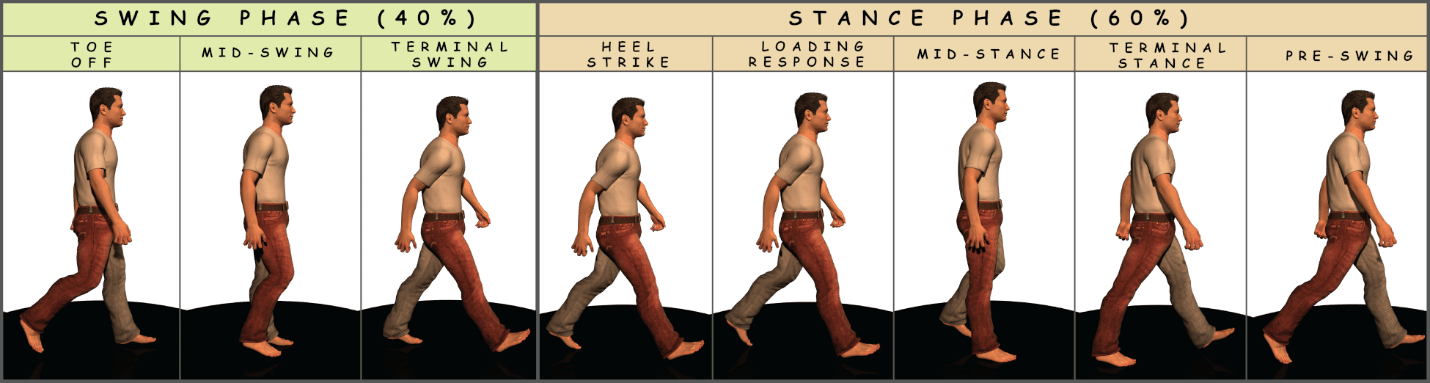 |
| Figure 1 – Normal Gait Cycle. The eight phases of human gait are highlighted by the right (red-shaded) limb. |
Trips occur when a person is walking and their foot unexpectedly strikes a raised object or surface during the swing phase (left three panels of Figure 1), resulting in a forward stumble and possibly a fall. Even a small, unexpected change in level on a walking surface can be sufficient to catch a toe and interrupt the forward movement of a foot during the swing phase. Uneven sidewalk panels, changes in flooring materials and slope, and loose footwear are all risk factors for trips. In many environments, the allowable height discrepancy between adjacent surfaces is greater than the average toe clearance during normal gait. For example, the Minimum Maintenance Standards for Municipal Municipal Highways[2] sets a threshold of 2 centimeters for the allowable height difference for a sidewalk surface discontinuity, whereas the clearance between the toe and the ground during the swing phase of gait can be less than 2 centimeters[3]. Thus, a trip on a sidewalk discontinuity is not sufficient to show that the sidewalk was in disrepair; instead, a measurement of the height of the discontinuity is needed to establish that the minimum standard was not met.
Slips, in contrast to trips, occur when the amount of friction required to perform an action, like walking or turning, is more than the available friction between the footwear and the walking surface. Slips leading to falls typically occur at heel strike (fourth panel in Figure 1), when adequate friction between the foot and floor is required to keep the foot from sliding forward. Contaminants, such as water, typically reduce the available friction and increase the risk of slipping. Questions about slips often come down to whether a floor is slippery when wet (see the next paragraph), but other risk factors for slips also exist, such as the type and condition of the footwear, the activity being performed, and the type of contaminant involved. For instance, worn out shoe soles may contribute to decreasing the available friction, and therefore photographs of the footwear and/or preserving the footwear after the incident can be important evidence in occupier’s liability cases.
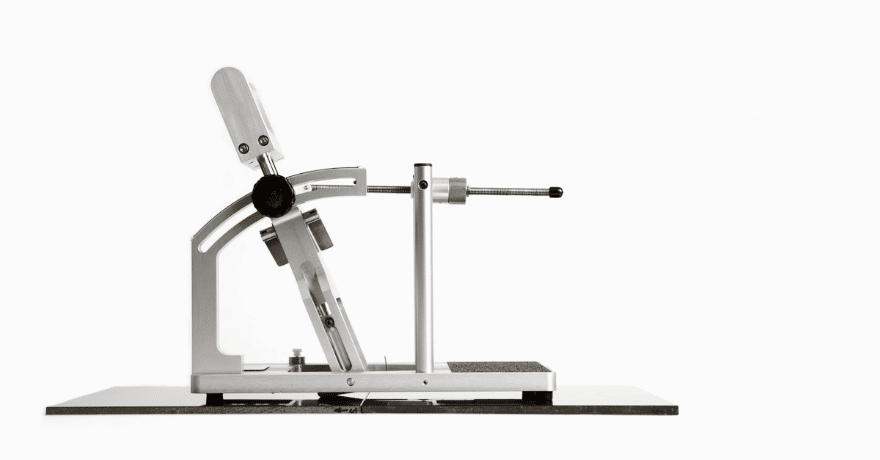 |
| Figure 2 – Example of one type of walkway tribometer. |
Some floor surfaces become slippery when wet and the degree to which their slipperiness changes can be measured using a walkway tribometer (Figure 2): a portable mechanical device that slides a rubber pad along the surface with or without a contaminant present. By comparing tribometer measurements made at the fall location to measurements of reference surfaces with known slipperiness, an expert can characterize the relative slipperiness of the floor involved in the incident.
There can be challenges to evaluating the results of tribometer tests. There are many different types of walkway tribometers and they all report different absolute values. These different absolute values mean that there is no universal friction threshold that differentiates a slippery surface from a slip-resistant surface; instead, this threshold will vary from tribometer to tribometer. And even within a single tribometer model, there is a relatively wide degree of uncertainty that is often not properly reported[4] [5]. An expert must take all of these factors into account to perform a reliable evaluation of a surface’s slipperiness and to present results that will stand up to cross-examination.
3. Injury Biomechanics
When there is neither surveillance video nor a reliable description of the fall, experts in injury biomechanics can sometimes determine how an incident occurred based on an analysis of the types and pattern of injuries. Injuries are a kind of physical evidence and can be used to determine the type and magnitude of forces that were applied to the plaintiff during the incident.
Certain injury patterns can represent a signature for a particular way forces were applied to the body. For example, a rolled ankle or a fracture can indicate how someone was moving or which direction they were travelling when they fell and hit the ground. Injuries can be matched to physical evidence at the scene and offer a more complete description of what took place.
Tips for Working with an engineer
Retaining the right expert in a slip, trip and fall case is important. A well-qualified expert will be familiar with the applicable standards and have the ability to relate any violation of these standards to a specific incident and injury. A biomechanical engineer with experience interpreting standards in the context of an injury incident can help connect these various elements. In some cases, specialized knowledge about industry standards may be best addressed by practitioners in the industry that can supplement or provide assumptions on which a biomechanical engineer’s analysis can be based. An expert that is clear about their scope of practice and provides proper referrals when needed is critical.
It is also important to retain experts as early as possible to inspect the site before any modifications, repairs, or improvements are made. Even if the area has changed, site measurements combined with photographs taken at the time of the incident can help determine the original configuration.
An experienced expert can also assist you with discovery questions to fill gaps in the evidence. General suggestions for discovery questions can be found on our website. Should you decide that an expert might be of assistance, consulting a well-qualified biomechanical engineer early in the proceedings can help sharpen your focus and move your case forward.
In summary, careful consideration of the following two questions can simplify a challenging occupiers’ liability case involving an injurious fall; i) was there a defect in the built environment, and; ii) did this defect cause or contribute to the incident. Answers to these questions sometimes require an expert who can quantify and explain the technical elements of each question, and thereby help the trier of fact reach a conclusion about whether a property-related defect caused or contributed to the plaintiff ’s injury.
[1] CSA-Z614 (2020) Children’s playground equipment and surfacing, 6th edition.
[2] Ontario Regulation 239/02: Minimum Maintenance Standards for Municipal Highways under Municipal Act, 2001.
[3] Begg R, Best R, Dell’Oro L, Taylor S (2007). Minimum foot clearance during walking: strategies for the minimisation of trip-related falls. Gait & posture, 25(2), 191-198.
[4] Chimich DD, Elkin BS, Siegmund GP (2020). Variability of friction measurements using three common walkway tribometers. Journal of Testing and Evaluation, 49(5).
[5] Siegmund GP, Blanchette MG, Brault JR, Chimich DD, Elkin BS (2021). Quantifying the uncertainty in tribometer measurements on walkway surfaces. Ergonomics, 64(3), 396-409.
As seen in The Litigator, Summer 2022.