

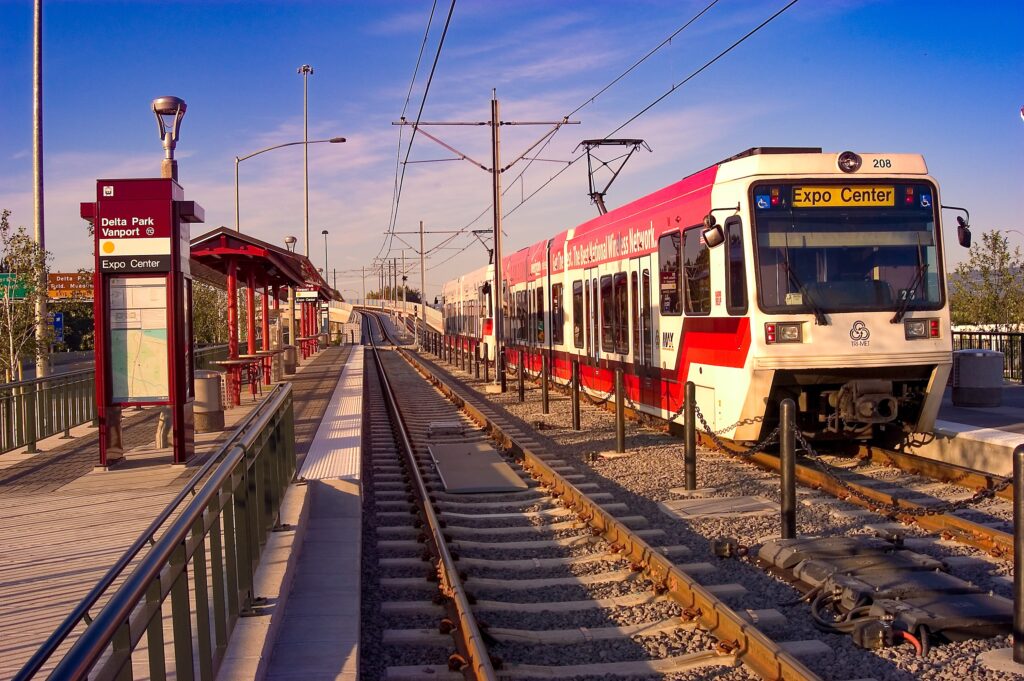
MEA Forensic reconstructed a collision between a pedestrian and a train from multiple video views, and provided insight into the contributing human factors.
The Event:
On her way home from work, a pedestrian was struck by a light-rail train at an at-grade crossing. Questions quickly arose about exactly what had happened, and who was liable. MEA Forensic was asked to make sense of multiple videos, reconstruct the moments leading up to the collision, and interpret events from a human factors point of view.
Our Analysis:
First, we synchronized the video from four cameras that captured the pre-impact movement of the train and the pedestrian. This analysis provided a complete description of the dynamics and two other key details:
- Visible through one of the windows of the train was a stopped minivan that temporarily obscured the pedestrian from the train driver.
- A reflection on the side of a waiting train showed the pedestrian was walking before she started to run towards the crossing.
A 3D computer model of the event scene was created from a series of laser scans so that the view of the various video cameras could be replicated. Scale models of the train, the minivan and the pedestrian were positioned in the computer model to match where they could be seen in the synchronized video frames. Using this position-matching technique, the movements of the train and the pedestrian in the moments leading up to the collision were determined precisely. Black box data downloaded from the train could also be synchronized with the video by aligning it with the stopped position of the train.
The results of our analysis showed that the train was going 19 mph at impact and was slowing, but the driver had not used the emergency brake. According to the black box data, the driver sounded the horn 1.9 seconds before impact, but why didn’t the driver apply the emergency brake? Our inspection of the train controls indicated that the emergency brake could not be engaged at the same moment as the horn. Both need to be operated by the right hand. Furthermore, we calculated that even if the driver had applied the emergency brake in reaction to the pedestrian emerging from behind the minivan, he could not have stopped the train short of the pedestrian, or even slowed it enough to allow her to clear in front. Had the pedestrian heard and responded to the start of the horn, she could have stopped short of an impact.

The positions of the train, the minivan and the pedestrian in the moments leading up to the collision were determined by overlaying video images on a scale 3D model of the event scene.
The Results:
Our detailed reconstruction based on multiple camera videos generated a clear and unified description of a complicated event. We were able to put the reaction of the train driver in context and consider the consequences of a different response for both the driver and the pedestrian.